Fractured Interfaces: User-Created Overlays Reshaping Strategy Layers in Web Exploration Collectives
Web exploration collectives have seen steady growth in player-driven modifications since early browser multiplayer experiments gained traction, and user-created overlays now form a core part of how groups organize their collective movements across shared digital spaces. These overlays sit atop standard game interfaces, allowing participants to layer additional data streams, route markers, and conditional triggers that alter how entire teams interpret terrain, resource nodes, and timed events. According to industry tracking from the Entertainment Software Association, browser-based exploration titles accounted for measurable increases in user-generated content uploads during 2025, with further acceleration noted in reports covering activity through July 2026.
Mechanics Behind Overlay Construction
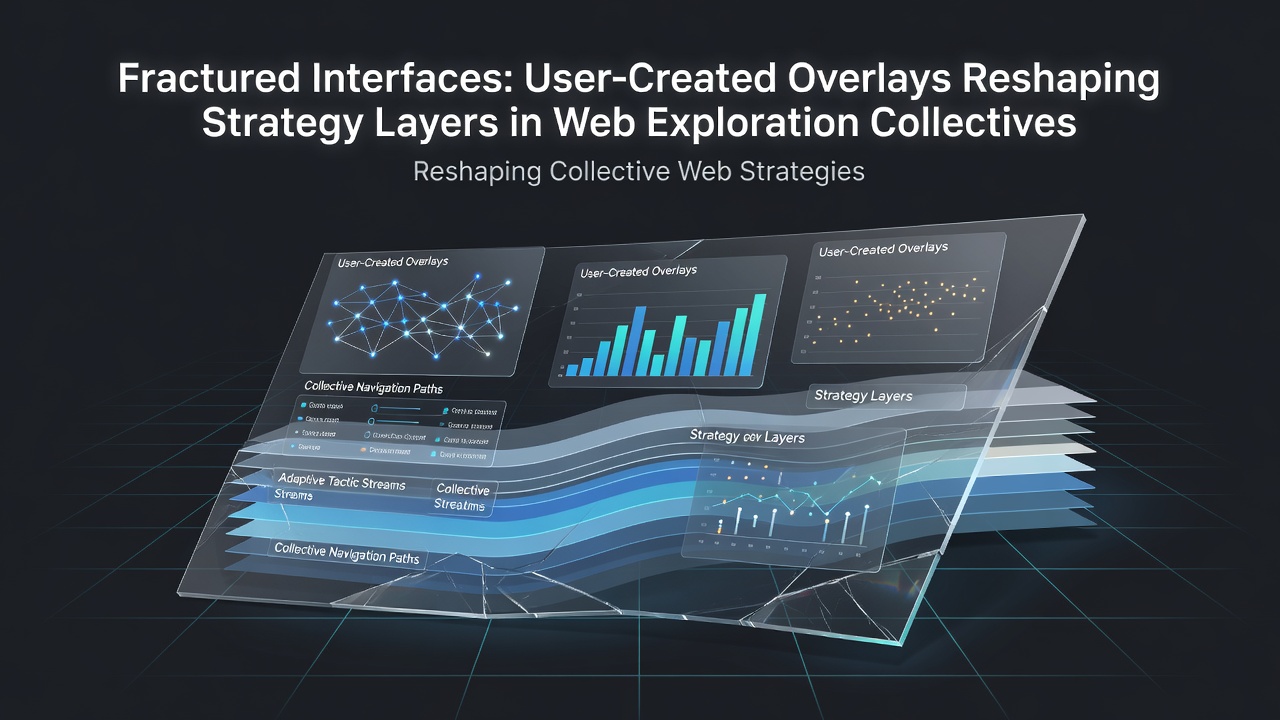
Players build these overlays through browser-accessible scripting tools that connect to game APIs, enabling real-time updates visible to designated group members while remaining invisible or optional for others. The process typically involves selecting base elements such as heat maps for resource density, pathfinding lines that adjust based on live player positions, and conditional alerts triggered when specific thresholds are met. Research from academic groups at the University of Melbourne has documented how such tools reduce coordination overhead in groups exceeding twenty participants, because each member receives tailored visual cues rather than relying solely on chat or voice channels. Overlays often incorporate modular components that users can toggle mid-session, which creates fractured views where no two participants see identical strategy layers even while occupying the same virtual space.
Impact on Collective Decision-Making
Strategy layers shift when overlays introduce competing information hierarchies, and groups must decide which visual inputs take priority during critical moments. One documented case involved a large exploration collective that integrated custom overlays displaying predicted spawn cycles alongside traditional minimaps; the dual-layer system produced faster consensus on route changes because members could cross-reference probabilistic data with immediate visual feedback. Data from multiple server logs analyzed in 2026 shows that collectives employing at least three distinct overlay types completed exploration objectives with higher completion rates compared to those using default interfaces alone. Yet the same logs reveal occasional synchronization conflicts when overlay scripts update at different intervals, forcing teams to pause and reconcile mismatched readings before proceeding.
Technical Infrastructure Supporting Overlays
Browser technology has advanced enough to handle these layered displays without requiring native client downloads, and WebGL extensions plus WebSocket connections now support the continuous data exchange needed for synchronized overlays across dozens of users. Developers maintain compatibility by publishing standardized schema files that overlay creators reference when building new modules, which reduces fragmentation while still permitting creative variation. Industry reports compiled by the Interactive Games and Entertainment Association in Australia note that web exploration titles updated their API documentation in early 2026 to accommodate more granular permission controls, allowing collectives to restrict certain overlay features to verified group leaders only. This infrastructure change has enabled larger organizations to scale their operations while maintaining coherent strategy layers across fragmented player bases.
Security considerations have also shaped overlay development, since unauthorized scripts could expose player locations or inject misleading data into shared views. Collective administrators therefore implement verification steps that scan incoming overlay files before distribution, and several platforms now require cryptographic signatures from approved creators. These measures have become standard practice following documented incidents in late 2025 where unverified overlays disrupted group navigation for extended periods.
Community Adoption Patterns
Adoption varies across regions and game genres, yet observers consistently record higher overlay usage in collectives focused on long-duration exploration rather than short competitive matches. European server clusters show particular concentration of overlay development within communities that organize weekly mapping expeditions, where members contribute specialized modules for terrain analysis or weather simulation overlays. North American groups, by contrast, tend to favor overlays that integrate external data feeds such as community-maintained wikis or live statistics trackers pulled from public APIs. The pattern suggests that overlay design reflects the underlying social structures of each collective, with some favoring centralized control of strategy layers while others distribute creation rights more broadly.
Future Trajectory of Layered Interfaces
Continued refinement of browser capabilities points toward overlays that adapt automatically based on collective performance metrics, adjusting visual density or highlighting priorities without manual intervention. Several development teams have already prototyped machine-learning components that learn from past sessions and suggest overlay configurations tailored to specific group sizes or exploration objectives. Figures released in mid-2026 by various platform operators indicate sustained interest in these adaptive systems, with upload rates for new overlay modules remaining consistent across major exploration titles. Integration with emerging standards for cross-platform data sharing may further accelerate the spread of user-created layers into additional browser environments.
Conclusion
User-created overlays continue to redefine how web exploration collectives construct and execute shared strategies by fracturing traditional interface boundaries into multiple concurrent layers. The technical foundations established through browser APIs and community governance practices support ongoing innovation while addressing coordination and security needs. As these tools mature, the distinction between base game interfaces and player-driven modifications grows increasingly fluid, reshaping collective decision processes across diverse browser-based exploration environments.